Custom Search

Sunday, January 31, 2010

Arrandale Based Fujitsu Tablet Hits FCC

Fujitsu is preparing a new tablet PC based on the upcoming Intel's Arrandale platform. The Fujitsu T900 codenamed "Souther" uses the next generation Intel Core-i7 quad-core processor.


The tablet is based on Intel QM57 chipset and features Intel Core-i7 620M 2.66GHz quad-core processor. It has a 13.3-inch display with 1366x768 screen resolution. The device will support 3G broadband access along with Atheros 802.11 b/g wireless LAN and Gigabit Ethernet. Details regarding availability and pricing are not released for now. Intel's next mobile platform is going to debut in the next few weeks which suggests that the tablet will be available in the start of next year.

GammaTech is offering 3 configurations for the E-Series Durabook:

NEC has released two new PCs, the desktop Mate ME and the laptop Versa Pro VD, which are well equipped to reduce your carbon footprint and help you fight inefficiency. If that's not enough, they also sport the latest CPUs from Intel.


The VersaPro VD notebook will come with Intel's Core i5 or Core i7 CPUs. A Core i5 configuration will be available with a 64GB SSD, 1GB RAM, Intel's new GMA HD graphics and Windows 7 Professional. On the green side, it comes with some handy preloaded software to help you monitor and control your energy use, which should already be low with the SSD and latest energy saving Intel hardware.

The Mate ME desktop sports the same low-energy hardware, from SSDs to Core i5/i7 CPUs to Intel's GMA HD. It also features environmentally friendly flame retardant bio-plastic and a specially engineered motherboard to increase efficiency by 30% while using less hazardous materials. It comes with the integrated software that the VersaPro comes with as well.

GammaTech Announces New Durabook E-Series with 1TB Storage

GammaTech's latest rugged notebook is particularly newsworthy for its 1TB of storage capacity, a first among fully ruggedized laptops.

GammaTech is offering 3 configurations for the E-Series Durabook: The E0 will use RAID-0 and the E1 will use RAID-1 with the dual 500GB drives, and the E2 splits the drives up into two for those who want to keep things separate. It will also feature a 14.1" display and a Core 2 Duo CPU of speeds greater than 2GHz, and up to 8GB RAM.

There is not yet known pricing or availability for this rugged notebook.

Video Camera Memory Card

A memory card is basically what it’s name suggests. It stores a memory or image of all photographs or videos taken by a digital camera. The modern day equivalent of the old movie or camera film, today they have transformed the way images and videos are stored and the quality of the stored images. Memory cards have replaced tapes and are fast replacing CDs and DVDs in music and video distribution industry as well.elecom-memory-card-reader-storage-case

The greatest advantage of all digital video cameras, apart from the higher quality of the camera lens etc., is of course the memory card. These cards have a capacity of anything up to 2GB’s. The cards can store videos of immense length, and once those have been transferred to a computer, they are back on the camera again, ready to roll for the next lot of videos. Most cameras come equipped with fairly small memory cards, and it is a standard procedure to purchase either one or two extra large capacity memory cards, depending on your storage requirements.

There are several formats of memory cards available. Each one of them is built for either one or two specific cameras, and you must check as to which one is compatible with your particular camera. The formats vary mainly on their speed and storage capacity. The quality of the image produced is generally similar in most video cameras, it is just the inbuilt compatibility requirements which differentiate each card. It is always recommended that you purchase a card which is compatible with more than one gadget, in order to avoid problems in the foreseeable future when you might want to upgrade or change your camera.

Saturday, January 30, 2010

ThinkPad X100e – Lenovo’s First Entry Ultraportable Laptop

lenovo X100e_black

Powered by choices of AMD Athlon Neo single and dual core processors and Turion dual core processors, the ThinkPad X100e has starting price of $450. This ultraportable laptop configured with 11.6-inch HD display, a full-size keyboard, a multitouch touchpad, and a Trackpoint. Available since January 5th, the X100e also offered in new color options such as Red. For connectivity, it supports 802.11n WiFi and optional Bluetooth and 3G.

The X100e delivers the full promise of VISION Pro Technology from AMD,” said Leslie Sobon, vice president, Product Marketing, AMD. “It delivers the visual experience necessary to leverage most of today’s collaboration tools, strong battery life and unbeatable value, all in a sleek, durable ultrathin laptop. With out-of-the-box support for dual monitors to enable greater productivity, the ThinkPad X100e defines what a commercial ultrathin laptop should be and sets the bar for future products based on VISION Pro Technology from AMD.”


Fujitsu’s UH900 Multi-Touch UMPC

6a00d83451c9ec69e2012876085

Fujitsu has announced its LifeBook UH900 as the smallest multi-touch handheld PC. Weighing less than 500g and measuring 20.4cm x 10.65cm x 2.38cm, the UH900 comes with a 5.6-inch touch screen supporting multi-touch with a resolution of 1280×800. This ultra-lightweight PC configured with a 1.6GHz Intel Atom Z530, 2GB of DDR2-533 RAM, Intel US15W chipset with GMA500 graphics processor, and a 62GB SSD. It’s also equipped with an SD card slot, two USB ports, and a webcam. Regarding connectivity, the UH900 supports b/g/n WiFi, Bluetooth 2.1+EDR, and inbuilt 3.5G (optional). Running on Windows 7 Home Premium, Fujitsu offers the device in three colors of choices: Mocha Black, Fiery Red, and Vintage Gold.


“Always in the forefront of delivering the latest technology coupled with stylish design and user-friendly features, Fujitsu has answered to the needs of today’s consumers for ultra-mobile computing gadgets that exude convenience and style with the new LifeBook UH900. Meticulously engineered and thoughtfully designed, the UH900 raises the bar in addressing the demanding needs of being constantly on the move,” commented Mr Raymond Foo, Associate Vice President, Product Marketing and Engineering, Fujitsu PC Asia Pacific.

Acer’s New Ferrari One Notebook PC

acer-Ferrari_One.back_cover

The new Acer’s new Ferrari One notebook PC powered by AMD Athlon™ 64 X2 dual-core processor, up to 4GB of DDR2 667MHz system memory, 250GB hard drive, and ATI Radeon™ HD 3200 Graphics to drive its 11.6-inch HD widescreen display. Measuring about one inch thin and weighing only 3.31 pounds, the Ferrari One also equipped with a built-in optical drive, two built-in stereo speakers, 3x USB 2.0 ports, and 1x VGA port. Other highlights: 802.11a/b/g/Draft-N WiFi, Gigabit LAN, Crystal Eye webcam, and Windows 7 Home Premium. You can take this notebook PC from now on with basic price beginning at $599.99

The New Versions of The OLPC’s XO Laptop is Coming


OLPC XO 3.0


OLPC XO 3.0
OLPC XO 3.0
OLPC XO 3.0
OLPC XO 3.0
OLPC XO 3.0

I know the XO children’s Laptop is less popular than other netbooks such as Eee PC, Aspire One, HP Mini, etc. But I also know that this OLPC’s laptop is actually the pioneer and others are the followers. After successfully distributing 1.4 million of XO 1.0. laptop to children around the world, OLPC plans to deliver its new version – XO 1.5, XO 1.75, and XO 3.0 until 2012.

The first version of OLPC’s child-centric laptop, the XO, is a revolution in low-cost, low-power computing. The XO has been distributed to more than 1.4 million children in 35 countries and in 25 languages,” said Nicholas Negroponte, founder and chairman of One Laptop per Child. “To fulfill our mission of reaching 500 million children in all remote corners of the planet, OLPC will continue to innovate in design and performance. Because we are a non-profit, we hope that industry will copy us.

New ThinkPad Edge Laptops


edge13-1L

Available in 13, 14, and 15-inch models, the new ThinkPad Edge laptops comes with spill-resistant keyboards and value-added ThinkVantage Technologies like the Active Protection System and Rescue and Recovery. It’s expected to hit stores starting in 2Q 2010 except the 13-inch version which should be available starting today with pricing of $549. Designed specifically for small to medium sized business (SMB) customers, the ThinkPad Edge features VISION Pro Technology from AMD.


“Small to medium business customers tell us they want PCs with bold yet professional designs, uncompromising durability and reliability with the latest technologies that meets their budgets,” said Fran O’Sullivan, senior vice president, Think Product Group, Lenovo. “Our answer is the new ThinkPad Edge family of laptops. They deliver stunning technology and powerful performance at an unprecedented value.”

Thursday, January 28, 2010

AMD Phenom II X2 555 and Athlon II X4 635 Performance

AMD is launching a bevy of new processors today, targeted squarely at budget conscious consumers, looking to save a few bucks on the their next PC build. The new processors differ from previous offerings in their respective product families in terms of frequency, and of course their model names, but all are based on existing architectures and technology.

The new line-up of processors AMD is introducing today consists of the following products...

  • Phenom II X2 555
  • Athlon II X4 635
  • Athlon II X3 440
  • Athlon II X2 255
  • Phenom II X4 910e

We decided to take the 3.2GHz Phenom II X2 555 and 2.9GHz Athlon II X4 635 for a spin and have their performance results posted on the pages ahead. Before we get to the numbers though, take a moment to peruse The Phenom II X2 555's and Athlon II X4 635's specifications in table below...

AMD Phenom II X2 & Athlon II X4 Processors
Specifications and Features

Phenom II X2

Athlon II X4

Model
Core Frequency
HyperTransport 3.0 Technology Link
Clock Multiplier
TDP (Thermal Design Power)
Number of CPU Cores
L1 Cache
L2 Cache
L3 Cache
Core Voltage (VID)
Manufacturing Process
Total Die Size
Packaging
Socket Compatibility
Memory Type
AMD PowerNow! Technology


555
3.2 GHz
4000 GT/s
16x
80W
2
256KB (2 x 128K)
1MB (2 x 512KB)
6MB
0.85-1.425V
45nm
258mm²
AM3 938-pin
AM2+, AM3
DDR2, DDR3
3.0
635
2.90 GHz
4000 GT/s
14.5x
95W
4
512KB (4x 128KB)
2MB (4 x 512MB)
0MB
0.825-1.425V
45nm
169mm²
AM3 938-pin
AM2+, AM3
DDR2, DDR3
3.0


2010: The top ten gadgets

1) Light Touch

The Light Touch from Light Blue Optics is a marvel -- it can beam a virtual computer on to any flat surface, allowing users to tap away as though on a proper keyboard. It's not commercially available -- the Cambridge-based company is hoping to license the technology to other manufacturers -- but if it does go on sale, it could herald a shift in the way we interact with the world around us.

2) Bloggie

Inexpensive, pocket-sized, web-friendly camcorders are two-a-penny, but Sony's challenger to the all-conquering Flip has some truly unique and useful features. The Bloggie has a detachable 360-degree camera that you can pop on top of the device. It means you can hold the camera steady while filming all around you. Load the footage on to a computer, and you can either play it back as a weird, circular movie, or 'unravel' the clip in to a strip, so that you view action as you would a conventional video.

3) Que

The Que, a cross between a tablet-style computer and an ebook reader, has been one of the stars of the show. Plastic Logic, the British-based company behind the device, say it is aimed at businessmen rather than consumers, allowing them to view and edit documents, download newspapers, manage their schedule and read ebooks on an entirely shatter-proof gadget. There's no UK launch date yet, but this sleek, lightweight device will prove popular with mobile workers and an early adopters when it goes on sale.

4) Sony 24in OLED 3D screens

Once again, 3D is big news at the show, with several manufacturers showing off the televisions we'll be able to buy for our living rooms in the coming months. But one of the most eye-catching 3D sets is Sony's prototype 24in OLED screen. OLED technology makes colours more vivid and blacks really dark and inky, and the pin-sharp picture is as crisp and vibrant as they come. Sony is coy about when it will start commercially producing larger versions of these OLED screens, but as soon as it does, consumers will snap them up; they make the current crop of LED television look as old-fashioned as a Bakelite.

5) Boxee

Boxee is a fantastic bit of software that can be installed on your computer or Apple TV to 'beam' the best web video content to your television. Users can access content from the BBC iPlayer, YouTube and Last.fm. But the people behind Boxee have decided to simplify the process further still by launching a set-top box, so users don't have to worry about the complicated process of downloading and installing software. The Boxee box is the size of a couple of CDs, and plugs directly in to your televison to stream the best of the web over your home broadband network. The box is available only in the US at the moment, but expect to see it in the UK before the year is out.

6) Lenovo IdeaPad U1

Lenovo's innovative 'hybrid' device is actually two gadgets in one -- it works just like a conventional laptop, or you can detach the screen and use it as a tablet-style computer. Lenovo says that the U1 suits the "dynamic lifestyles" of users by cleverly combining the functionality of a notebook with the touch-screen interactivity offered by the tablet. We're likely to see the U1 on sale in the UK later this year.

7) Parrot AR Drone

Augmented reality -- in which real-world images are overlaid with useful data, information or rich content -- is set to be one of the big success stories of 2010. Some experts even expect the technology to filter down to the world of video games, and that's what Parrot's drone was designed to showcase. The helicopter-style drone, powered by four small blades, floats lazily through the air. On board are two mini video cameras, which send images back to an iPhone, which is running a special app that transforms the device in to a remote control for the chopper, as well as a video game. By tilting the iPhone, players can change the direction of the quadricopter, while images beamed back from the chopper are overlaid with virtual pictures of monsters or aircraft zooming across the screen. Parrot's drone is purely a proof of concept, but all the experts believe augmented gaming will be commonplace within the next two year.

8) Panasonic 3D TV
CES wouldn't be CES without an impossibly huge television from Panasonic, and one of the highlights of this year's show is the Japanese company's 152in plasma screen 3D TV. It's made from several plasma displays fused together, and is unlikely to appeal to consumers (unless they have a huge living room), but expect to see it in posh hotels and luxury shopping centres in the coming months.

9) Zyxio Sensawaft
Have you ever wanted to control the cursor on your computer using only your breath? No? That's a shame, because that's exactly what the Sensawaft does. By blowing in to a special 'microphone', you can control the speed and direction of the cursor across your computer screen. Zyxio, the company behind the technology, says it could be very useful for disabled computer users, and also envisage it being applied to other scenarios, such as controlling a mobile phone, being used as a "third hand" when playing an action-packed video game, or even operating in-car sat-nav. We'll see the first Sensawaft devices go on sale later this year, costing around £60.

10) Entourage eDGe

With Apple rumoured to be launching its own tablet-style computer later this month, you'd forgive other manufacturers if they sat back to see what Apple did before releasing their own products. But Entourage has decided to lead where many are choosing to follow, unveiling a dual-screen tablet-cum-ereader that shows just how elegant this technology can be. The eDGe features an eInk screen on the left, for reading ebooks, annotating copy and taking notes; on the right is an LCD screen running the Android operating system, that can carry out simple computer tasks such as emailing and web browsing. The device can be opened backwards on itself, so you can hold it in one hand and look at one screen. It will cost $490 when it goes on sale in the US next month, and UK gadget fans will be hoping that a British launch follows soon.

Intel WiDi Wireless Display Technology - HOT


At this year's CES show in Vegas there have been more than a couple of relatively exciting announcements and of course Intel was intent on joining the party. Today we got to spend some quality time behind closed doors with the folks in Intel's mobile group learning a bit about some of the new features that will be coming to their Core i5 and Core i3 Mobile platforms in the weeks ahead. We heard some fairly inspiring things about the technology back in the November time frame at a cozy bistro in New York city but today we were able to see it in action and it was impressive to say the least.

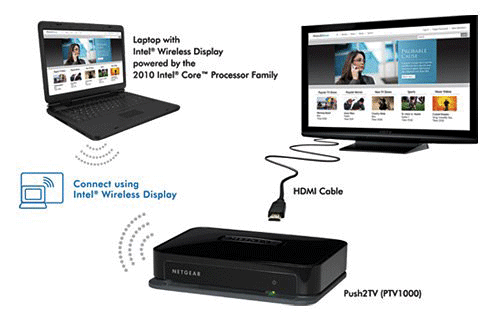
Intel's new WiDi (Wireless Display Interface) technology will start to be bundled with various Core i5 and Core i3 notebooks later this month and it promises to address the Home Theater and Multimedia PC markets with a solution that will enable wireless connectivity of your notebook over HDMI to an HDTV. Using standard 802.11n wireless technologies for transmission of data, Intel describes the product as "a solution that requires a laptop PC based on select 2010 Intel Core processors, Intel HD Graphics, and intel centrino wireless with Intel MyWiFi Technology enabled. The laptop needs to have Intel Wireless Display software installed and also an adapter featuring Intel Wireless Display is required to receive the signals from the PC that display them on the TV. This adapter is connected to the TV via either HDMI or standard AV cables."

Netgear has stepped out early with a receiver product dubbed Push2TV and their block diagram below lays out the solution for you here...

Netgear partnered with Intel to develop the Push2TV WiDi Receiver

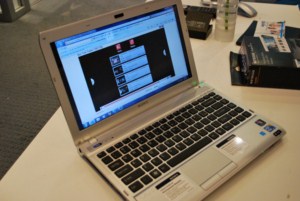
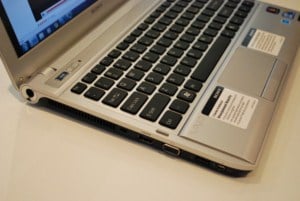
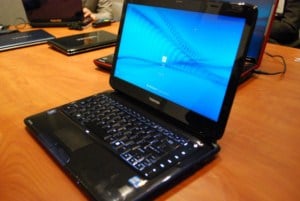
Here are a few close-ups of the Sony and Toshiba notebooks we saw today demonstrating Intel WiDi. Both machines strike a stylish balance of portability and performance; Sony's machine taking ultra-thin design cues while Toshiba's machines was bit with a little more glitz perhaps, depending on your perspective.


Sony's Sleek VAIO Notebook Based On Core i5 Technology with WiDi On Board


Toshiba's New Core i5, Backlit and Cool with Core i5 and On-Board Intel WiDi Tech

We've seen more than a few sites at this year's 2010 CES but often times we're left flat with all of the pre-announcements before the show, leaving not as many new things to see live at the show and stealing some thunder from what otherwise would perhaps pique our collective geek interest. We'd have to say that Intel's Wireless Display Technology demo definitely impressed us more than just about anything we've seen thus far, though we're not quite done yet, if you can believe that.

Regardless, we're looking forward to the day that we can test Intel's new Wireless Display Technology on our own. We'll be sure to keep you posted as we get product in hand. In the mean time, we'd like to thank Intel for making the trip to Vegas a little more worth while.


Tuesday, January 26, 2010

Dell Studio 1747 (Intel Core i7) review


Dell Studio 1747 (Intel Core i7) laptop review

Building on the strong foundation of its excellent Studio 15, Dell's Studio 1747 packs the same stunning quad-core power and usability, while adding a larger screen and improved graphics and sound; making it a fantastic and affordable multimedia machine.

Performance is truly stunning. Built around the same Intel Core i7 processor as the Studio 15, the same level of quad-core power is on offer, making light work of even the most demanding software tasks. For high-performance use, there are currently few machines more capable.

While this isn't the most graphically advanced laptop on the market, 3D performance vastly exceeds the smaller Studio 15 - almost doubling its power. Whether for basic gaming or high-definition movie and photo editing, this is a laptop you can rely on to deliver all you need.

The stunning 17.3-inch screen adds to its graphical ability. Its sharp resolution and well-balanced colour and contrast deliver a fantastic picture for gaming, viewing photos and watching movies. While the screen is also extremely bright, images never appear washed out.

HDMI, VGA and DisplayPort connections are provided, allowing you to connect to external HDTVs, projectors and monitors. DisplayPort is still quite rare on laptops, but is seen by some as superior to HDMI when connecting PCs to external screens, so it is nice to see both here.

Of particular note is the inclusion of an integrated speaker and subwoofer set-up from audio specialist JBL. While most laptops deliver incredibly weak audio performance, this set-up produces surprisingly warm and powerful sound, ideal for enjoying music, games and movies.

As with the Studio 15, the excellent keyboard and large keys ensure comfortable usability. Despite the board flexing very slightly when typing, all keys are accurate and responsive. A full pad of number keys on the board's right-hand side allows quick and easy data input.

The large touchpad and mouse buttons are as accessible and responsive as the keyboard, and add to the overall usability. While our review sample did not feature a touchscreen panel, the 17.3-inch screen can be customised with multi-touch interactivity for an extra £180.

Impressive storage rounds out the overall package. A capacious 500GB hard drive and an 8-in-1 media card reader provide comprehensive fixed storage and support for external flash-based multimedia cards, ideal for sharing data with devices such as digital camera.

By offering improved graphics and audio performance, Dell's Studio 17 is a great alternative to its Studio 15, for those that require extra multimedia power and don't mind the larger chassis size. Unless you require cutting-edge gaming power, it is a fantastic home laptop.

Dell Inspiron 11z review

Dell Inspiron 11z - review


Dell Inspiron 11z - review

Following the critical success of its Inspiron Mini netbook range, Dell has built on its foundation with the CULV Inspiron 11z (£439 inc. VAT). Built around a similar chassis to its predecessors, it provides power, usability and a great battery life at a very affordable price.

While the Mini range came in a choice of screen sizes, ranging from 9 to 12 inches, this is an 11.6-inch machine. Its 16:9 widescreen aspect ratio is perfect for watching movies, although since there is no internal optical drive, videos have to be played directly from the hard drive.

The screen isn’t the brightest or most vibrant, but is sharp, with adequate colour and contrast. It is highly reflective, hindering visibility in bright conditions and it doesn’t fold back very far, making it tricky to get a comfortable viewing angle.

Despite the use of a very bulky battery, the slim chassis remains light at 1.6kg. It retains the high-quality feel of the Inspiron Mini range, with resilient plastics used, but the glossy lid is prone to scratches. It is tough enough for frequent travel use, however, and a good choice for the kids.

The keyboard stretches the width of the chassis and is comfortable to use. All keys are large and accessible with an accurate, if a little spongy, typing action. The touchpad is strangely wide and measures 80 x 46mm. It responds well, but its dimensions hinder accessibility.

While you can buy the 11z with a smaller 3-cell battery, our test unit came with the optional 6-cell module. Despite increasing the depth of the rear of the chassis from 28mm to 48mm, it runs for a stunning 520 minutes, easily allowing a full day’s work on the move.

The ultra-low voltage design of the Intel Pentium processor reduces heat output, while its dual-core capability ensures office tasks run quickly at all times. Of course, it can’t match the power of larger machines, but it functions very well for basic use at home or when travelling.

The 320GB hard drive doubles the capacity of most netbooks, providing ample storage. While there is no integrated optical drive, flash storage card support is provided by a 6-in-1 media card reader.

High-speed wireless network connectivity is provided by 802.11n Wi-Fi. Bluetooth is also included for wirelessly sharing files and synchronising data with external devices. A webcam is built into the screen panel and Microsoft Works software provides basic office tools.

The Inspiron 11z is an intriguing proposition. By providing more power, mobility and features than a netbook for a similar price, it represents better value for money and makes a more attractive choice for the frequent traveller.

Acer Aspire 5738DZG (3D-screen) review

Acer Aspire 5738DZG 3D laptop review


Acer Aspire 5738DZG 3D laptop review

Although the Acer Aspire 5738DZG-434G50Mn (£584 inc. VAT) looks like other machines in Acer’s consumer range, it offers an innovative feature that marks it out from any laptop we’ve seen to date – a screen that offers full 3D images.

The 15.6-inch screen itself looks like a regular Super-TFT panel. It’s glossy, resulting in reflections in brighter conditions, but brightness and colour reproduction are good. Putting on a pair of polarised spectacles – which are provided in the box – sees the screen change dramatically, however, with all the pixels a lot more noticeable.

The icons that looked crisp without them now look hazy and it’s difficult to focus on regular 2D content. To achieve the 3D effect, images are reproduced more than once onscreen. As such, the screen is blurry and un-viewable without wearing the glasses, but images combine and appear to jump out of the screen as soon as you put them on.

Content made especially for the technology is incredibly realistic, including cartoon videos and photographs. Acer also bundles software to turn your own media content into 3D, but we didn’t find this as impressive. While there’s no doubt the technology works, impressing everybody who tried the laptop, we found varying side effects after ten to twenty minutes – from headaches to dizziness and nausea – a result of trying to trick your brain into seeing something that doesn’t exist.

As a regular laptop, there’s plenty on offer here. The mid-range ATi Mobility Radeon HD 4570 graphics card provides enough power for light gaming and running intensive multimedia applications. Everyday office performance isn’t quite so impressive, with an Intel Pentium processor used to keep the price down. It’s still fine for most uses, however, using dual-cores and 4096MB of memory to make multi-tasking a possibility. Battery life, at 191 minutes, is good enough for most uses, allowing you to take this machine on the road where necessary.

In terms of design, it’s similar to Acer’s existing Aspire models, with a glossy-blue lid and contrasting grey plastics inside, with excellent build quality throughout. The keyboard is large, with clearly defined keys that provide an excellent typing action. The large touchpad also offers great usability.

It’s impossible not to be impressed by the Aspire 5738DZG-434G50Mn and its 3D display. We were genuinely surprised at just how well the technology works, making movies especially fascinating. However, by also making us feel slightly queasy, it remains to be seen whether changes to the technology can make it more comfortable to view.

Mesh Edge DX review


Mesh Edge DX DirectX 11 laptop review

Established over twenty years ago, UK-based Mesh offers a range of laptops from affordable entry-level systems to high-powered gaming machines. Its Edge DX (£899 inc. VAT) is a quad-core powerhouse and the first laptop to offer full support for DirectX 11 graphics.

While DirectX 11 has been available for some time and is built into Windows 7, there has been no hardware support for laptops until now. By using ATi's Mobility Radeon 5650 graphics card, the Edge DX is able take full advantage of the API's for improved graphics performance.

When compared to ATi's previous 4650 GPU, our graphics tests revealed around 15 per cent more power on offer. Games run smoother and faster than before, and HD video editing tasks are equally enhanced, making this a highly capable gaming and multimedia machine.

As well as such powerful graphics, Mesh has fitted Intel's latest Core i7 quad-core processor alongside 4096MB of DDR3 memory. The result is stunning levels of power for frequent and demanding multi-tasking, and this is one of the most powerful laptops you can currently buy.

This is all the more impressive when you consider the comparatively portable 2.8kg chassis. While the 148-minute battery life falls far below the three-hour minimum we expect, this machine is more than portable enough to comfortably carry between gaming LAN parties.

The impressive build quality on offer adds to this, with strong plastics and firm panels in evidence throughout. Despite housing such powerful components, a highly effective cooling system is in place, allowing the chassis to remain at a consistently comfortable temperature.

The glossy silver and black colour scheme provides a subtle yet effective style – somewhat resembling HP's consumer Pavilion range. The glossy lid manages to hide smudges and fingerprints surprisingly well, but the rather cheap looking branded sticker lets things down.

Where this machine further excels is its impressively bright and sharp 15.6-inch screen. Offering a Full HD resolution and vibrant colour reproduction, movies and games look fantastic. Even the glossy Super-TFT coating impresses, with reflections kept to a minimum.

Usability is also excellent, with the keyboard proving accurate and responsive. The keys move quietly and firmly, and the wide touchpad and mouse buttons allows easy control of onscreen actions. A fingerprint scanner is also in place for safeguarding your valuable data.

Although this isn't the most powerful gaming laptop we've seen, it is certainly a very capable machine and one of the best we've seen from Mesh. And the inclusion of full DirectX11 GPU support makes it all the more appealing for gamers and ardent multimedia fans.

Samsung NB30 rugged netbook


Samsung NB30 - rugged netbook

Samsung has added the NB30 to its impressive range of netbooks. The 10.1-inch machine’s main selling point is that it boasts various rugged features, and is aimed at those who work in the field or simply after a netbook which will provide an extra layer of protection for their data.

Three major differences separate the netbook from its rivals, and those are the scratch resistant surface, hard drive with a free fall sensor (for protecting your data if the laptop is dropped) and a water resistant seal designed to keep out accidentally spilt liquids.

The NB30 is powered by Intel’s latest Atom processor, the N450, which aims to provide a longer battery life than previous generations of the chip, and Samsung claim an alleged 11 hours of use from a single charge.

1024MB of memory is included, as is a 250GB hard drive, web cam, Bluetooth and 802.11n Wi-Fi.

Monday, January 25, 2010

Gateway EC1400-31K CULV 11.6 inch Notebook

gateway-ec1400-31k-culv-notebook

Gateway announce EC1400-31K CULV notebook, notebook that’s using CULV (Consumer Ultra-Low Voltage) technology. Gateway EC1400-31K CULV notebook specs just like 11.6-inch 1366 x 768 resolution widescreen LCD display, measures in at 285 x 204 x 22.1mm and weighs just 1.4kg, 1.2GHz Intel Celeron SU2300 dual core CPU under the hood paired with Intel’s GS45 Express chipset. Full specs below:

Gateway EC1400-31K CULV specifications :

  • 11.6-inch 1366 x 768 resolution widescreen LCD display
  • measures in at 285 x 204 x 22.1mm
  • weighs just 1.4kg
  • 1.2GHz Intel Celeron SU2300 dual core CPU
  • Intel’s GS45 Express chipset
  • 2GB of RAM
  • 250GB hard drive
  • 3 megapixel webcam
  • integrated Wi-Fi (802.11b/g/n)
  • Bluetooth V2.1 wireless connectivity
  • three USB 2.0 ports
  • HDMI port allowing for HDTV hook-ups.

Dual Screen Notebooks - They're Here, and Competing with one Another

10254_main_OnkyoDXDualScreen.jpg

Dual screened notebooks have become more than concept - we've gotten to the point where two versions of a similar dual screened netbook are competing with one another over price and features. Excellent.

Around two months ago we speculated about the future of dual screened notebooks, taking note of past entries and current concepts andprototypes. Since then, that Kohjinsha prototype has gone on sale, delivering close to but not quite what was promised at CEATAC. And more recently still, before the Kohjinshas would have been delivered in fact, an Onkyo rebadge of the dual screened netbook has appeared, essentially offering a superior product for the same price.

Companies don't compete like this unless they see there is a market for it, and that means good things for the dual screened market. I'm not sure what the volume of orders Kohjinsha received was, but it was apparently enough that somebody else wanted to get in on the action and profits.

In case you were wondering, the Kohjinsha DZ sported netbook sized 1.02 x 8.26 x 0.74~1.65 inch dimensions and a weight of 4.09 pounds. Of course, it had the dual 10.1" displays, although each only managed a maximum resolution of 1,024 x 600. For a processor you get an HD capable 1.6GHz AMD Athlon Neo to go along with 1GB RAM (upgradable to 4GB) and a 160GB 5400RPM HDD. Battery life was supposedly 4.5 hours and it packed Windows 7 Home Premium. The cost found on their website is currently ¥79,800 ($909).

The Onkyo DX, on the other hand, features a resolution of 1,366 x 768 on each display - which is what had been promised at CEATEC in the first place. It also upgrades the HDD to a 320GB 7200RPM unit, and starts you off with 2GB RAM (similarly upgradable to 4GB). The price (as listed on their website) jumps incrementally to ¥84,800 (~$966) for these upgrades.

It's still too early to say if this isn't destined to be a niche market, but this competition assures us that there is at least a real market of some kind for this kind of device. Or, at least, that the kind of people paid to research if there is a market for something thinkthere's something here. Because when it comes down to it, you're still paying nearly $1,000 for the processing power of a netbook - and I'm not sure there are many would be willing to pay that much.

Whether this new genre lives or dies may come down to whether there is enough demand to continue to lower that price point. At what point would you buy a dual screened netbook? Or does ~$1,000 sounds reasonable enough for you, given all those wonderful pixels? Let us know what you think in the comments.